You can share
- Share to Facebook
- Share to Google+
- Subscribe to our
- Share to Linkedin
- Share to Twitter
You can share

Promotional product safety is no longer just a technical checkbox—it is a critical brand protection requirement for corporate buyers, event organizers, and distributors sourcing custom lapel pins, medals, challenge coins, and keychains. When distributing branded metal merchandise to employees, clients, or event attendees, organizations assume legal liability and reputational exposure under stringent international consumer safety frameworks such as California Proposition 65, the US Consumer Product Safety Improvement Act (CPSIA), and the European Union’s REACH regulation. Ensuring that custom metal items are manufactured from certified virgin zinc alloy, finished with non-toxic enamels, and sealed with nickel-safe electroplating is the only reliable way to prevent hazardous substance non-compliance, costly product recalls, and customs seizure.
According to regulatory advisories from the Promotional Products Association International (PPAI) Product Responsibility Action Group (PRAG) and consumer protection enforcement data, heavy metal migration (particularly lead and cadmium) and sharp mechanical edges account for the majority of compliance penalties in decorative hard goods. For B2B procurement managers, establishing verifiable supplier testing protocols before issuing purchase orders ensures safe, fully compliant branded gifts that protect both end users and corporate brand equity.
Corporate gifts and event merchandise frequently come into direct skin contact and are often shared within households, meaning they must meet the same rigorous consumer protection standards as retail consumer products.
When sourcing promotional metal items—such as die-cast zinc alloy lapel pins, stamped brass challenge coins, or commemorative award medals—procurement teams face three primary compliance risk vectors:
Substrate Heavy Metal Contamination: Low-cost recycled scrap metals frequently contain trace amounts of lead, cadmium, and arsenic. Unverified alloy ingots can easily breach the strict 90 ppm to 100 ppm total lead thresholds established by international safety laws.
Surface Coating Toxicity: Synthetic enamel colorants, silk-screen printing inks, and clear epoxy domes must be formulated without banned phthalate plasticizers or hazardous solvent residues.
Plating Leachability and Skin Sensitivity: Electroplated finishes (such as bright nickel, imitation gold, or antique bronze) must be sealed with electrophoretic clear lacquer to prevent prolonged skin contact friction from causing nickel-induced allergic dermatitis.
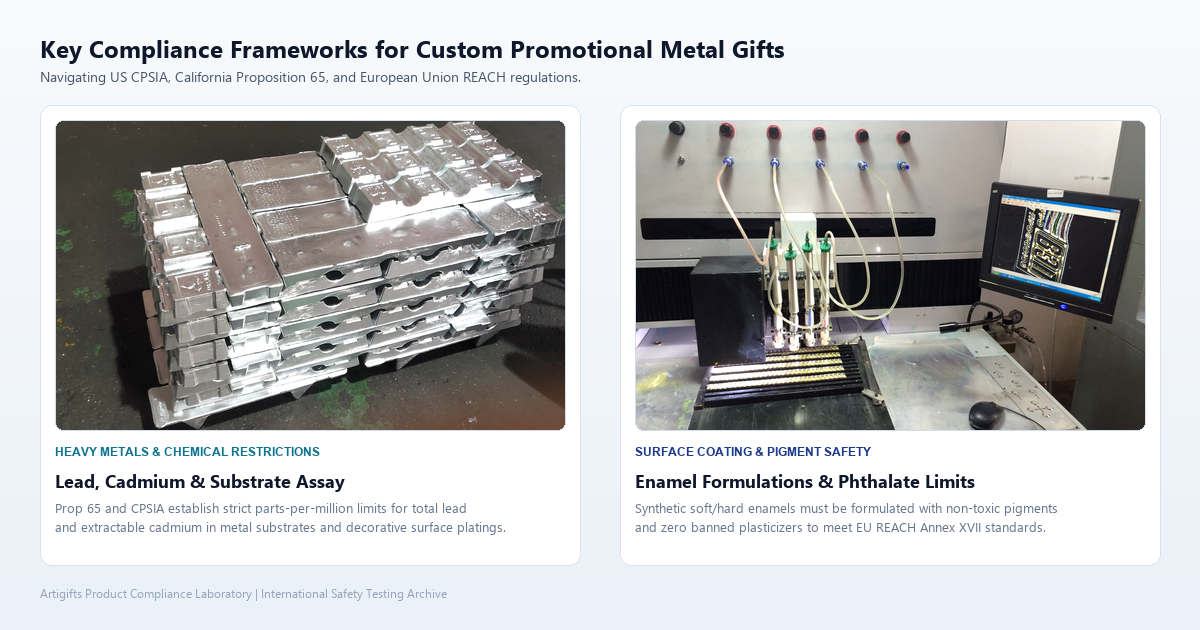
Navigating the global regulatory landscape requires understanding how different target jurisdictions enforce chemical and mechanical safety standards on promotional items.
California’s Safe Drinking Water and Toxic Enforcement Act of 1986 requires businesses to provide clear warnings if consumer products expose individuals to any of over 900 listed chemicals known to cause cancer or reproductive toxicity. In the promotional products sector, private enforcement actions (60-day notices) regularly target metal keychains, lapel pins, and drinkware accessories for exceeding lead (Pb) and cadmium (Cd) limits. Sourcing metal gifts certified below Prop 65 settlement thresholds (typically lead < 100 ppm in substrates and < 90 ppm in surface coatings) eliminates the need for alarming warning labels on executive merchandise.
If promotional merchandise is distributed at family festivals, educational events, or school competitions where children aged 12 and under may interact with the product, CPSIA mandates strict compliance:
Total Lead Content: Maximum 100 ppm across all accessible metal substrates.
Lead in Paint/Surface Coatings: Maximum 90 ppm (16 CFR Part 1303).
Phthalates Restriction: Maximum 0.1% (1,000 ppm) across eight specified plasticizers in flexible materials.
Children's Product Certificate (CPC): Mandatory testing through a CPSC-accepted third-party laboratory.
Under EU REACH Annex XVII, promotional metal items entering the European single market must comply with:
Cadmium Restriction (Entry 23): Cadmium content in metals and plastics must not exceed 0.01% by weight (100 ppm).
Lead Restriction (Entry 63): Lead content in articles supplied to the general public must not exceed 0.05% by weight (500 ppm), or demonstrate a release rate below 0.05 µg/cm²/hour.
Nickel Release Limit (Entry 27): For items intended for direct and prolonged skin contact, nickel release must not exceed 0.5 µg/cm²/week (EN 1811 test method).
Before signing contracts with custom gift manufacturers, enterprise buyers should verify how their order specifications align with jurisdictional safety thresholds.
| Regulatory Standard | Target Jurisdiction | Regulated Substances & Scope | Mandatory Threshold Limit | Key Promotional Product Impact |
|---|---|---|---|---|
| California Prop 65 | California / US Nationwide | Lead (Pb), Cadmium (Cd), Phthalates | Lead < 100 ppm (substrate), < 90 ppm (coating) | Avoids mandatory warning labels on corporate gifts |
| US CPSIA (16 CFR) | United States | Total Lead, Phthalates, Small Parts | Lead < 100 ppm, Phthalates < 0.1% | Mandatory for event medals & pins accessible to kids |
| EU REACH (Annex XVII) | European Union | Cadmium, Lead, Nickel Release | Cd < 100 ppm, Pb < 500 ppm, Ni < 0.5 µg/cm²/wk | Prevents customs impoundment across EU border points |
| RoHS Directive | EU & Global Supply Chains | 10 Hazardous Substances (Pb, Cd, Hg, Cr VI) | Pb < 1000 ppm, Cd < 100 ppm | Standard benchmark for eco-friendly metal hardware |
| Mechanical Safety (ASTM/EN) | Global Markets | Sharp Points, Burrs, Attachment Tensile | Zero hazardous burrs, secure clutch pull | Protects against accidental skin scratches and detachment |
Achieving consistent compliance requires comprehensive raw material control and multi-stage testing throughout the custom metal manufacturing cycle.
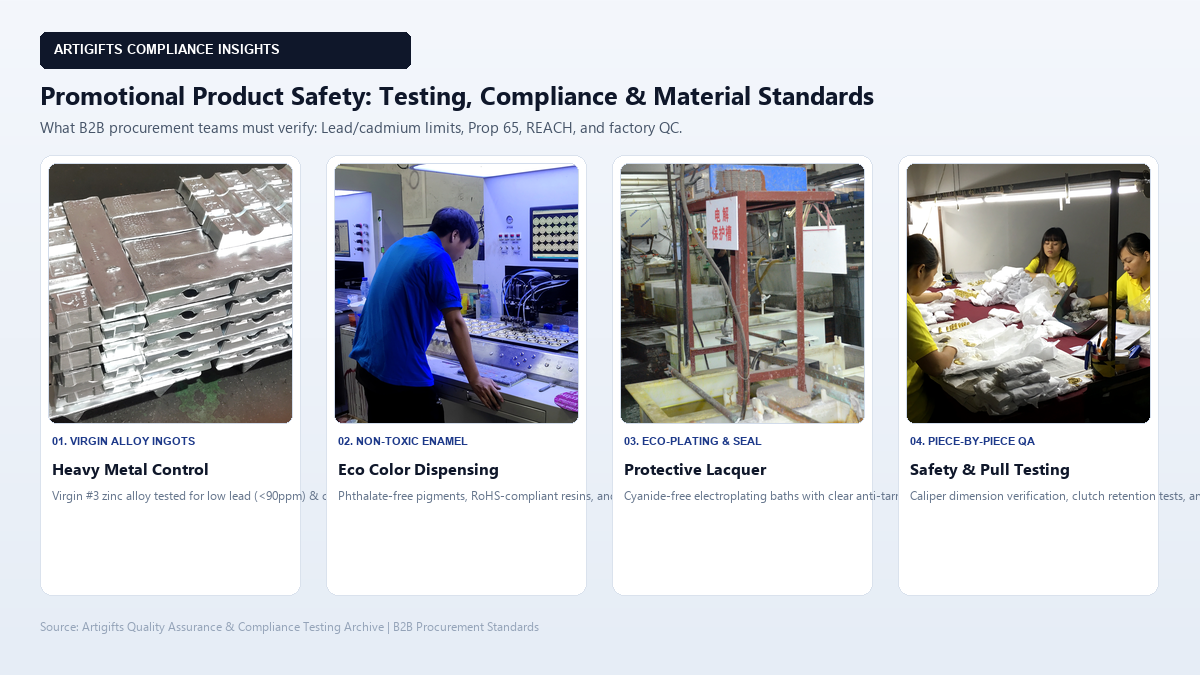
Reputable manufacturers utilize certified virgin #3 zinc alloy ingots rather than remelted post-consumer scrap. High-purity Zamak delivers exceptional fluid castability for intricate 3D reliefs while keeping native lead and cadmium impurities well below 50 ppm—safely under all international thresholds.
Modern soft and hard enamel infill utilizes high-density synthetic resins colored with non-toxic, heavy-metal-free pigments. Automated CNC dispensing ensures precise cavity filling followed by controlled high-temperature oven baking, producing inert, chemically stable color fills that resist chipping and leaching.
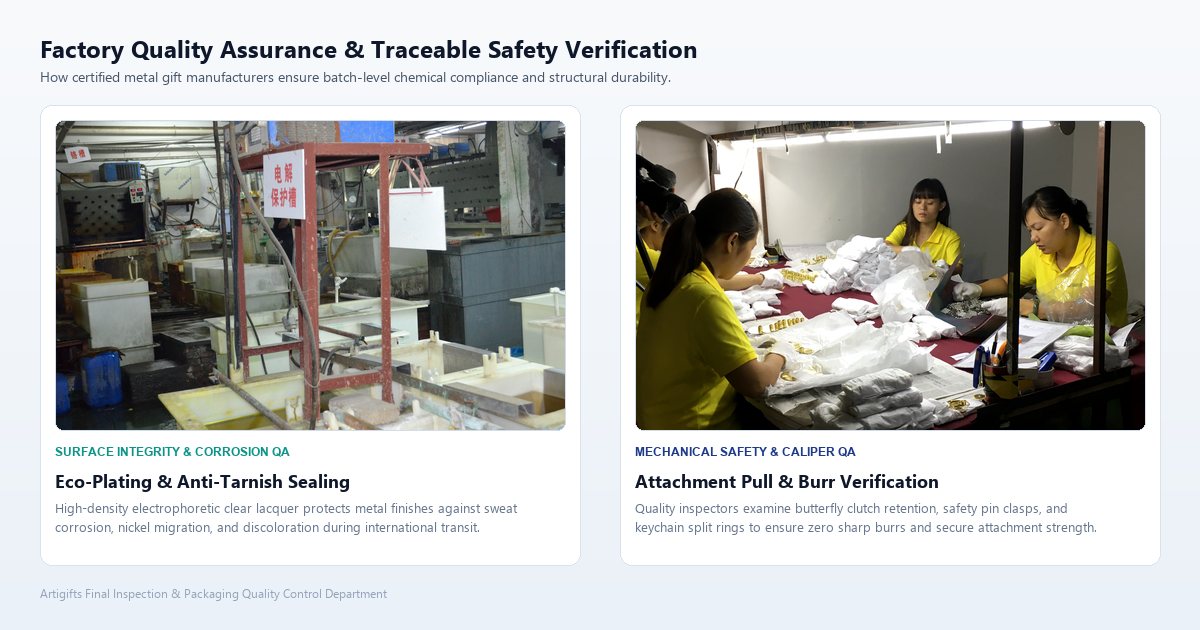
After electroplating (gold, nickel, brass, or antique finishes), items pass through advanced clear electrophoretic passivation and lacquer baking baths. This ultra-thin, transparent protective barrier prevents atmospheric oxidation and locks in metallic ions, effectively neutralizing nickel skin migration.
In addition to chemical safety, custom lapel pins, medal neck ribbons, and keychains undergo mechanical QA:
Clutch Retention Pull Tests: Verifying that butterfly clutches and rubber backings require at least 15–20 N of force to detach.
Deburring & Rim Polishing: Automated vibratory tumbling and hand-buffing to eliminate sharp metal flashes and burrs.
Ribbon Safety Breakaways: Ensuring event lanyards and neck ribbons feature quick-release buckles when specified for athletic or youth events.
When sourcing custom metal gifts, commemorative coins, or event lapel pins, verify these eight critical safety checkpoints before approving production:
Specify Target Markets Upfront: Inform your supplier whether items will be distributed in the US, California, the European Union, or global corporate branches.
Demand Virgin Alloy Certification: Require mill test certificates confirming the use of virgin #3 zinc alloy or high-grade brass.
Request Recent Third-Party Test Reports: Obtain batch testing documentation from accredited independent laboratories (such as SGS, Intertek, or TÜV) covering Prop 65 and REACH compliance.
Verify Non-Toxic Enamel & Ink Safety: Ensure all color pigments and surface coatings are certified phthalate-free and low-VOC.
Confirm Nickel-Safe Plating Protocols: Specify clear protective lacquer sealing for items intended for daily handling (keychains, challenge coins, lapel pins).
Check Intended Audience Age Group: If items could be distributed to participants under 12 years old, mandate full CPSIA / ASTM F963 compliance testing.
Inspect Pre-Production Physical Samples: Check pre-production samples for smooth edge deburring, clasp stability, and enamel curing hardness.
Ensure Traceable Packaging: Verify that master shipping cartons include clear batch tracking numbers and manufacturer identification.
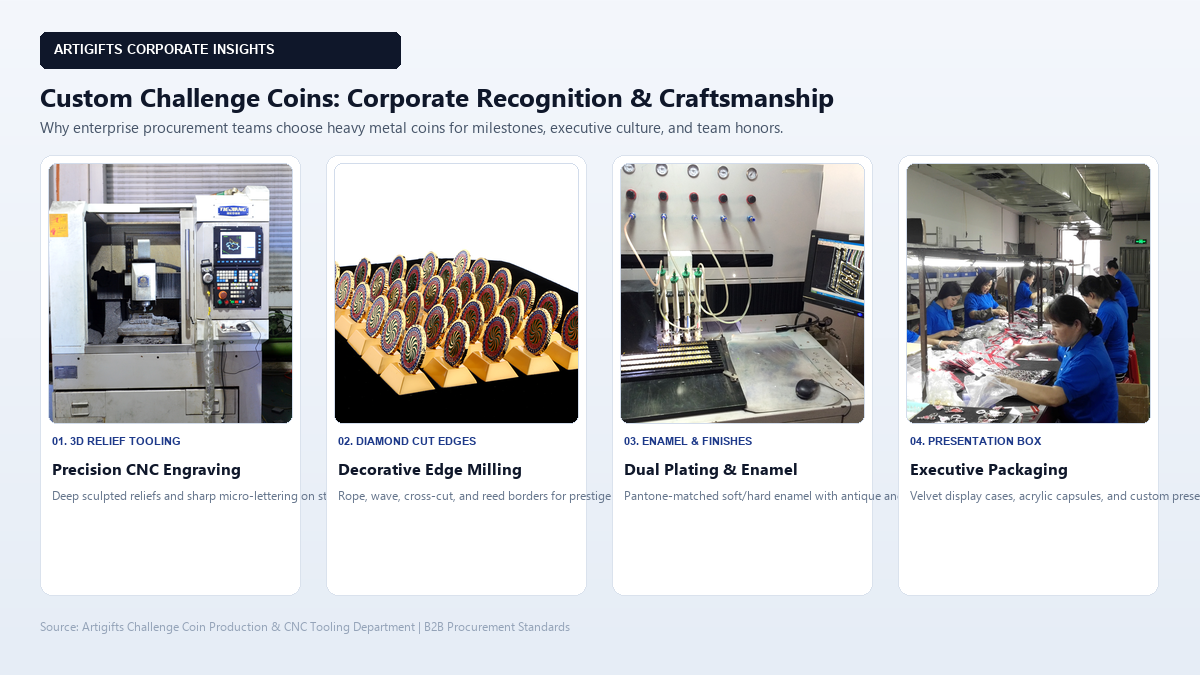
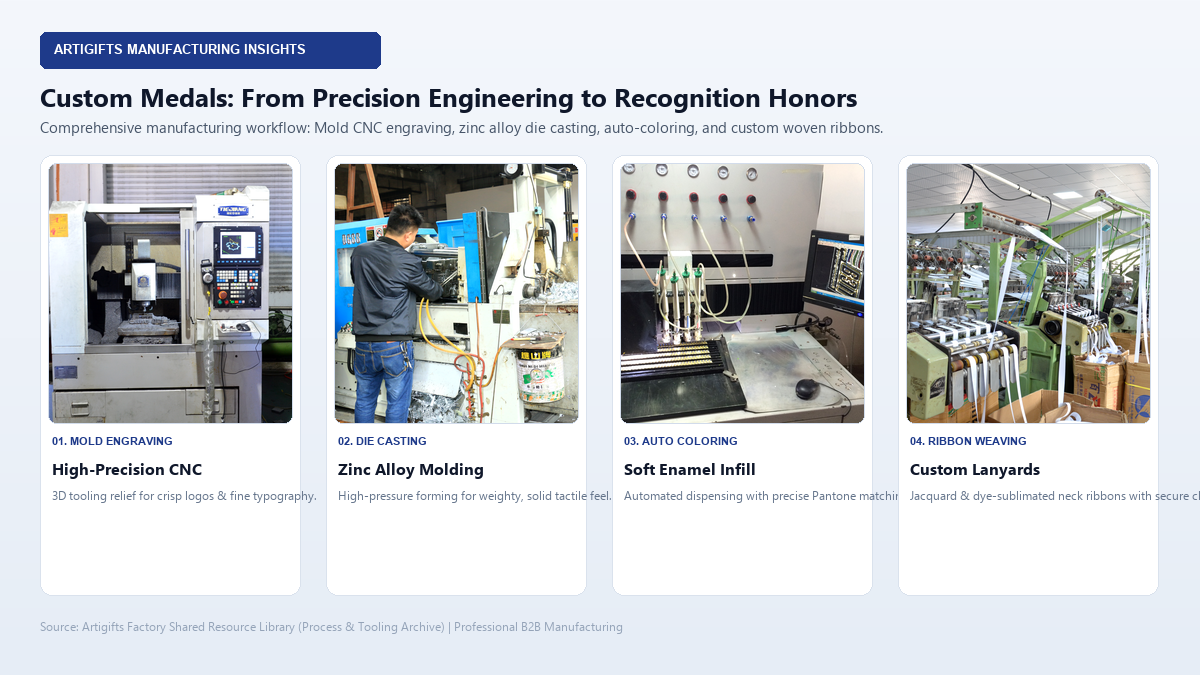
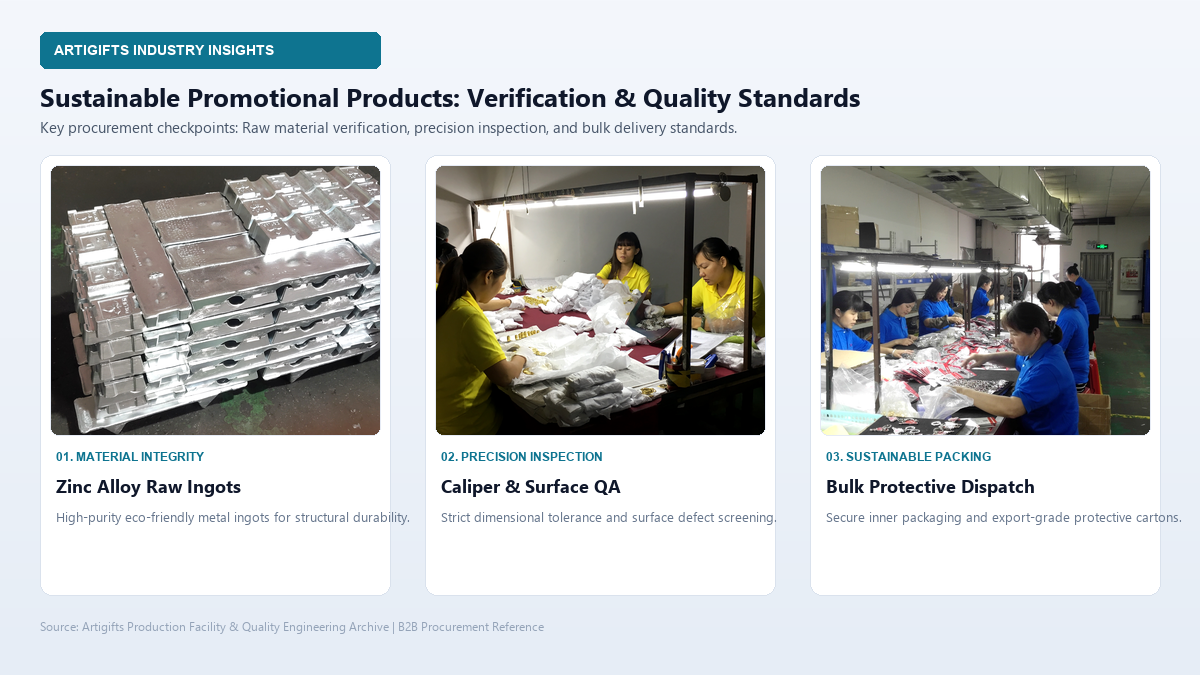
At Artigifts, product safety, environmental responsibility, and structural quality form the foundation of our custom metal manufacturing operations. Serving multinational enterprise brands, promotional product distributors, and global sports organizations, our manufacturing facilities adhere to strict ISO 9001 and ISO 14001 quality and environmental management systems.
From raw virgin alloy inspection to automated color dispensing and protective lacquer baking, every batch of custom lapel pins, custom challenge coins, and custom medals is built to satisfy international safety benchmarks including California Prop 65, CPSIA, and EU REACH. Combining advanced production with verifiable sustainable promotional product standards, Artigifts provides corporate buyers with dependable, audit-ready merchandise that elevates brand prestige.
The two most frequent compliance failures are excessive lead or cadmium levels in low-grade scrap alloy substrates and high nickel release rates from unsealed electroplated surfaces. Sourcing from manufacturers utilizing certified virgin #3 zinc alloy and protective electrophoretic lacquer prevents these issues.
Yes. Proposition 65 applies to all consumer goods distributed in California, regardless of whether they are sold in retail stores or handed out as free promotional gifts at corporate conferences, trade shows, or employee events.
CPSIA applies specifically to products designed or intended primarily for children aged 12 and younger. It enforces a strict 100 ppm total lead cap, 90 ppm paint lead limit, small parts choke hazard testing, and requires a formal Children's Product Certificate (CPC) issued by a CPSC-accepted laboratory. General adult merchandise is governed primarily by Prop 65 and general consumer product safety guidelines.
Visual inspection cannot detect heavy metals. Enterprise buyers should request third-party lab test reports (e.g., from SGS, Intertek, or TÜV) using Inductively Coupled Plasma Mass Spectrometry (ICP-MS) or X-ray Fluorescence (XRF) screening performed on the specific raw material batch.
Yes, provided they are formulated with non-toxic, heavy-metal-free pigments and phthalate-free resins. Reputable custom gift manufacturers use REACH- and RoHS-compliant synthetic enamels that cure into an inert, non-leaching solid finish during high-temperature oven baking.
Procurement teams should request: (1) Raw material mill test certificates (MTC) for zinc alloy or brass, (2) Total lead and cadmium assay reports, (3) Nickel release test results for wearable metal items, and (4) Material Safety Data Sheets (MSDS) for enamels and surface coatings.
Promotional Products Association International (PPAI): PPAI Responsibility & Sustainability Hub — Best practices, product safety guidelines, and regulatory compliance standards for promotional merchandise distributors and suppliers.
PPAI Product Responsibility Action Group (PRAG): PRAG Regulatory Roundup & Compliance Updates — Analysis of US federal and state consumer safety regulations, Proposition 65 enforcement actions, and supply chain accountability.
PPAI Prop 65 Industry Guidance: California Prop 65 Requirements for Promotional Products — Practical compliance thresholds and risk mitigation strategies for corporate gift buyers.
PPAI Sustainable Procurement Research: Using Ecolabels and Standards to Find Sustainable Products — Frameworks for evaluating material safety, chemical restrictions, and environmental certifications in branded merchandise.
About Artigifts Custom Metal Manufacturing & Quality Systems
Custom Challenge Coins: Corporate Recognition & Craftsmanship Guide
How Custom Medals Support Employee Recognition and Event Experiences
Sustainable Promotional Products: Verification & Quality Standards
Contact Our B2B Team for Compliance Documentation & Inquiries